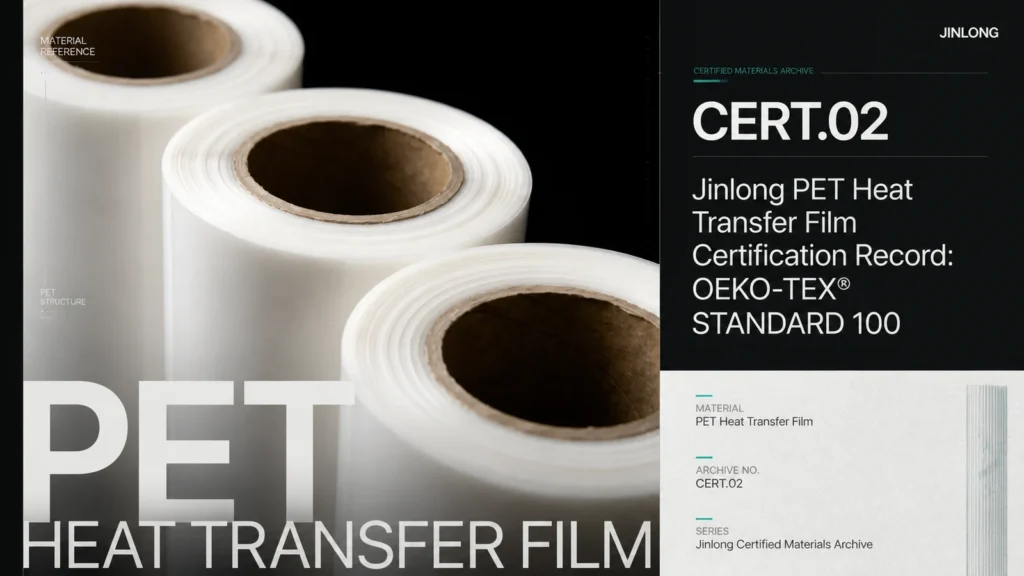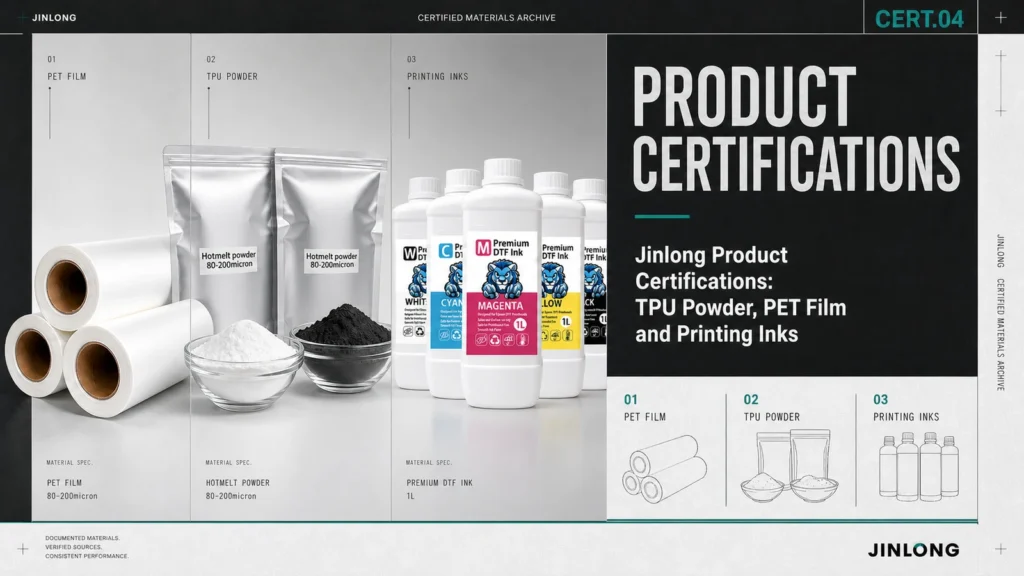
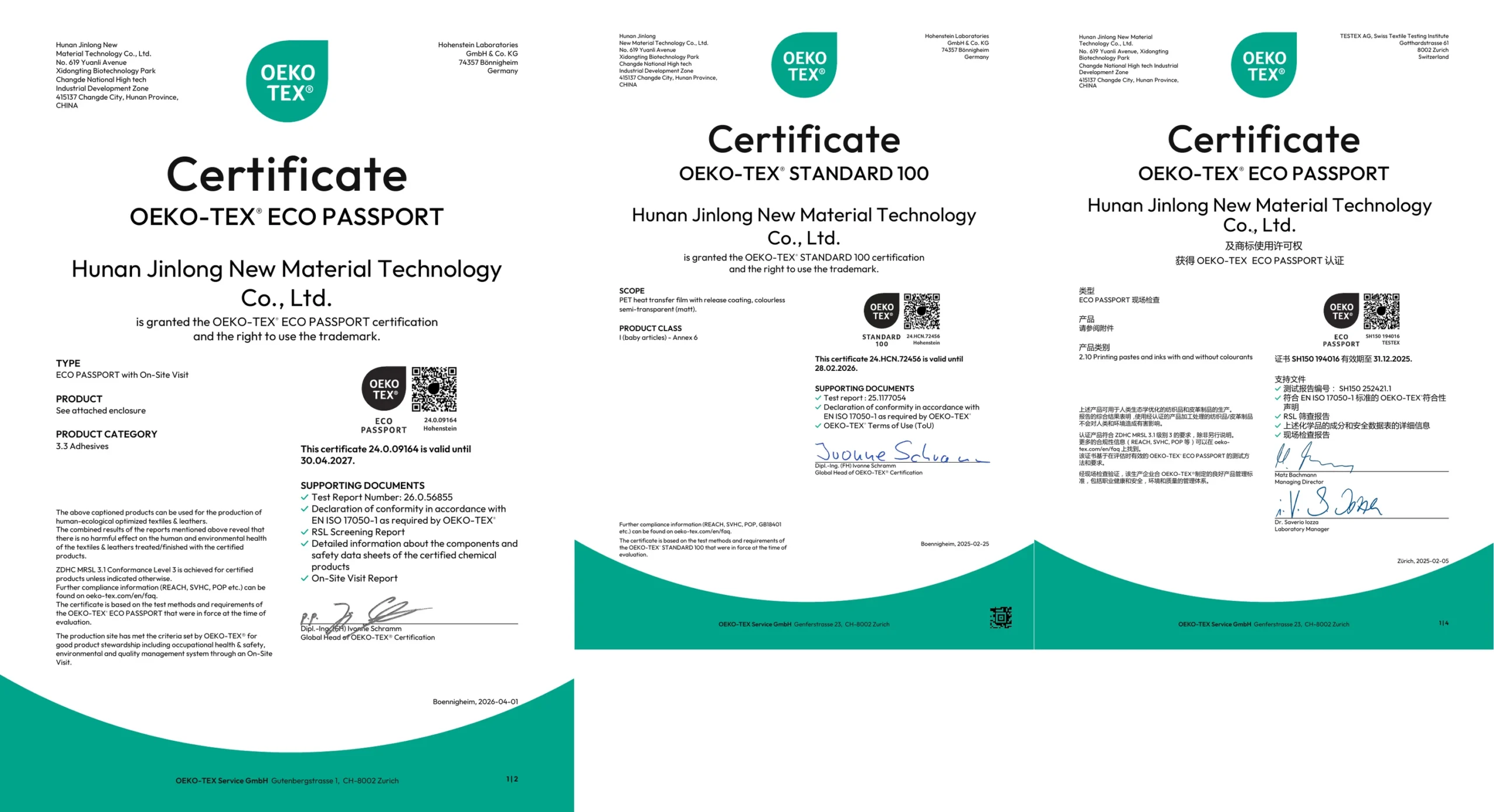
Jinlong has obtained OEKO-TEX® certification records for TPU hot melt powder, PET heat transfer film and water-based printing inks. These certificates demonstrate Jinlong’s ongoing product-compliance work. The current TPU powder certificate is valid through April 30, 2027; the PET film and printing-ink certificates shown here are historical records.
Jinlong certification overview
| ECO PASSPORT | STANDARD 100 | |
|---|---|---|
| Typical focus | Chemicals, colourants and auxiliaries used in textile or leather production | Tested textile-related products and components within a defined scope |
| Jinlong examples | TPU hot melt powder and historically listed water-based printing inks | Historically certified PET heat transfer film with release coating |
| What to verify | Exact chemical product, trade name, category, restrictions and certificate validity | Exact product description, product class, annex and certificate validity |
ECO PASSPORT for DTF chemical inputs
DTF hot melt powder functions as an adhesive input, while printing inks are chemical formulations. ECO PASSPORT is therefore the relevant certification type in the Jinlong records reviewed for these materials. The certificates identify the product category, supporting test report, ZDHC conformance information and any restrictions listed in the enclosure.
Jinlong’s current TPU hot melt powder certificate is an ECO PASSPORT with On-Site Visit, valid through April 30, 2027. Older water-based ink documentation belongs in the historical certificate archive because its validity ended in 2025.
Historical STANDARD 100 certification for Jinlong PET heat transfer film
A separate historical Jinlong certificate used STANDARD 100 for a colourless semi-transparent matt PET heat transfer film with release coating. That certificate recorded Product Class I under Annex 6. Because its validity ended on February 28, 2026, it should be presented as historical testing evidence rather than a current certification claim.
A certified input does not automatically certify the finished transfer
A DTF transfer combines film, ink, hot melt powder, curing, pressing and a target textile. Certification of one input does not automatically certify the complete transfer or finished garment. Buyers working under a brand restricted-substances program or a finished-product certification scheme should confirm the required testing scope with the relevant laboratory or certification body.
Five checks before accepting a certificate
- Match the supplier’s legal company name.
- Match the exact product name, trade name and certificate enclosure.
- Check the certificate number, issue date and expiry date.
- Read restrictions and downstream testing footnotes.
- Request the current document for the product offered on the quotation.
Build documentation into material testing
Documentation review should run alongside production testing. Share your printer, film width, ink configuration, powder requirement, fabric and target market with Jinlong. The team can help identify the relevant product documents and prepare a matched material sample for your process.